
When the idea of creating what we today call the GRAMMA Cultural House first took root in my mind, my concerns were not commercial, but deeply human, ethical, and existential. I often wondered: “How can a house that speaks of culture, writing, and introspection ignore the silent wounds of the modern industry?”. Thus, ethical fashion became more than just a marketing choice; it became the only honest answer to the values I wished to serve and pass on.
Founding the GRAMMA House was not an easy decision made overnight. Every “Letter” (Gramma) we compose, every stitch we add, every object we design, carries an ethical weight. My greatest concern from the very beginning was ensuring absolute integrity throughout the entire production chain.
In a world dominated by the anonymity of mass production, GRAMMA had to be the antidote. I did not want to be just another link in the chain of harsh and unconscious consumption, but a pillar of culture that “embraces” human existence at all its stages.
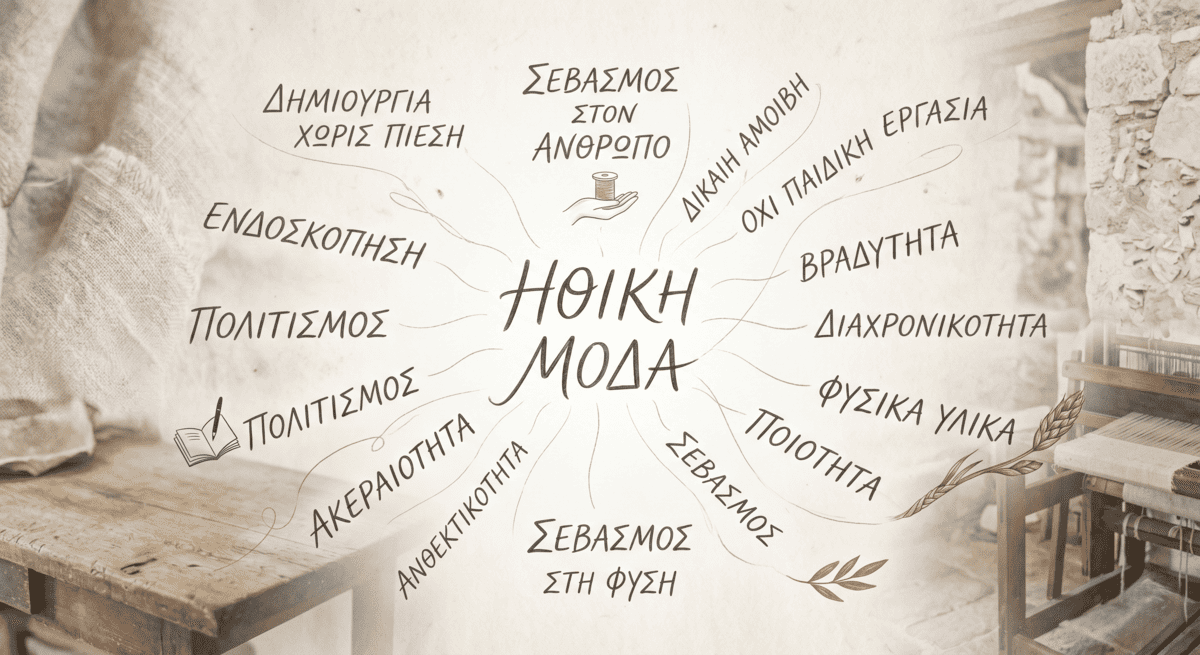
One of the most painful and dark concerns I had to face was the issue of child labor. It is a plague that, although we all know of it, is often overlooked behind shiny shop windows and low prices. For me, this was my “red line.”
At GRAMMA, we arrived at an absolute position: We meticulously examine and audit every one of our suppliers based on this criterion. We cannot speak of “Mazes” of self-awareness and spiritual elevation if we are not certain that the hands that touched our fabrics were free hands—hands that were paid fairly and were not deprived of the right to childhood and learning. The protection of childhood is the foundation upon which we build every partnership, from Samos to the ends of the world.
In GRAMMA’s ethical fashion, we consciously chose a method of production that refuses to succumb to the panic of time. The “Fast Fashion” industry has imposed a frantic pace where collections must be born in a specific month and “die” in another, only to give way to the next pile of unclaimed clothes.
At GRAMMA, we choose slowness. Our production does not hurry, because creation requires time to acquire a soul:
For us, ethical fashion is synonymous with timelessness. At GRAMMA, you will not find “firework” clothes that lose their shape or value after three washes. We create objects that have no expiration date.
Every garment of ours belongs to a specific pillar—such as the “Isychastirio”—and carries a depth that remains unalterable. When you choose a GRAMMA garment, you know its background. You know it was designed in Pagondas, Samos, inspired by our Journal and our literary research. It is a “cultural translation” upon your body, a chapter of a story that continues through you.
I am often asked why I insist so much on quality. The answer is simple: Quality is the highest respect towards the person who trusts us. In ethical fashion, this respect translates into the durability of the object. We respect your money, your time, and your aesthetics.
We do not wish to sell you something ephemeral. We want to offer you a faithful companion. Much like the handmade maze-game made of olive wood that accompanies my book “The Maze,” our garments are tools of introspection. They invite you to stop for a moment, to breathe the scent of natural fabric, and to feel the weight and history you carry.
My vision is for GRAMMA to be established as an alternative path in the global market. A path where writing, reading, culture, and fashion meet under the common roof of ethics. I want you to feel, when you visit Samos and our headquarters in Pagondas, that here, creation embraces humanity and nature with authentic love.
Ethical fashion is our promise for a future where beauty will not be produced at anyone’s expense. Thank you for choosing to be fellow travelers on this journey. Your support is our strength to continue creating with ethics, depth, and culture.
With respect and love,
Evangelia Grammatiki