

The history of human thought is woven with invisible threads that cross continents, seas, and centuries, uniting different cultures under the same universal quest for truth. If in the previous part of our journey we saw how a humble, rough rope brought order to the muddy chaos of the Nile, it is now time to see this thread travel into the light of the Aegean. The relationship that develops between the concepts of Pythagoras and Arpedoni is not merely a historical footnote. It is the pivotal moment where the practical need for survival is transformed into a high, timeless philosophy.
To understand the magnitude of this transition, we must follow in the footsteps of one of the most brilliant and mysterious minds of antiquity, returning to our roots, to the island of Samos.
Pythagoras was not merely a theoretical mathematician. He was a tireless traveler, an initiate of knowledge who thirsted to understand the deepest rules that govern the universe. Born in the 6th century BC in Samos, an island bustling with maritime and commercial activity, he found himself at the crossroads of civilizations. At that time, the Eastern Mediterranean was an open road for the exchange of ideas.
His quest led him to Egypt, the cradle of ancient wisdom. There, among the monumental temples and imposing pyramids, the young Samian philosopher was initiated into the secrets of the Egyptian priests. It was there that he first observed the “arpedonaptes” (rope-stretchers) in action. He saw them take a simple rope, divided by 12 perfectly equidistant knots, and stretch it on the ground to form a triangle with sides of 3, 4, and 5. The result was always the same: a perfect, infallible right angle.
They used it to build walls that would not collapse. Pythagoras, however, saw something much deeper. The encounter of Pythagoras and Arpedoni was the moment when the human gaze pierced through matter and saw the invisible architecture of the world.
Why is the concept of Pythagoras and Arpedoni so defining? Because Pythagoras realized that the secret was not hidden in the material of the rope. Whether the thread was made of linen, hemp, or papyrus, the result was immutable. The secret lay in the proportion. It was hidden in the numbers.
The philosopher perceived that the stretched rope was simply the physical manifestation of a universal, immaterial truth. The square of the longest side (the hypotenuse) is always equal to the sum of the squares of the other two sides. This is exactly how the famous Pythagorean Theorem was born. The word “theorem” comes from the Greek verb theoro, which in antiquity meant to observe with reverence, to see clearly with the eyes of the mind.
The duality of Pythagoras and Arpedoni shows us the transition from the empirical to the theoretical. The rough tool of the Egyptians became the canvas upon which the Greek thinker painted the laws of nature itself.
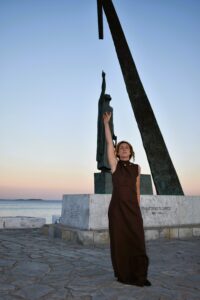
When Pythagoras returned to the Greek world, he brought this precious legacy with him. However, the light of the Aegean gave things a different meaning. Geometry in Ancient Greece no longer served the sole purpose of survival or building tombs for the Pharaohs. It became the path toward the search for virtue, beauty, and truth.
In the philosophical school he founded, the idea that emerged from the relationship between Pythagoras and Arpedoni evolved into the theory of Universal Harmony (the Harmony of the Spheres). Pythagoras taught that the universe is not a random sum of matter, but an organized “cosmos” (a word meaning ornament, order). He argued that “all is number,” meaning that everything is governed by harmonious proportions. Just as the knots on the arpedoni rope created a perfect angle, so too do the distances of the planets or the lengths of the strings on a lyre create the perfect melody.
The connection of Pythagoras and Arpedoni was not limited only to mathematics or music. It profoundly influenced the way the ancient Greeks perceived architecture, sculpture, and, of course, the human silhouette itself.
The Doric columns of the temples, the golden ratio we find in statues, the absolute symmetry that soothes the viewer’s eye—all stem from the same philosophy of correct proportion. Pythagoras believed that the human body is also a microcosm, a temple that obeys the same geometric rules as the universe. When the body is in harmony, it radiates health, beauty, and serenity.
The stretched thread of the arpedoni became the symbol of balance between tension and relaxation. If the rope is too loose, you cannot measure. If it is stretched too tight, it will break. The perfect fit requires respect for proportion.
By deeply understanding the chapter of Pythagoras and Arpedoni, we realize that geometry is not something cold or distant. It is the deepest, most organic language of nature. It is the sense of “rightness” we feel when we look at a perfect sunset in the Aegean, when we listen to a harmonious piece of music, or when we touch a fabric that embraces the body with respect.
The thread that once measured the earth in Egypt and later measured the starry sky in Samos was never cut. It continues to unroll through the centuries, reaching all the way to today. It reminds us that absolute freedom is not found in chaos, but in quiet, effortless structure.
But how can this awe-inspiring ancient legacy, this strict geometry of Pythagoras and the Arpedonaptes, be transmuted today into something as tangible and personal as a garment? How do the rope and the knot become tools of contemporary aesthetics?
This transition from the ancient theorem to the modern garment is the vision we will explore in the third and final part of our journey, discovering how the Chapter of Arpedoni came to life through the collections of Evangelia Grammatiki.
What does Pythagoras have to do with arpedoni? In the story we tell, Pythagoras, born on Samos in the 6th century BC, saw the harpedonaptai in Egypt shape a triangle of 3, 4 and 5. He moved from the tool to the theory, and from there to the Pythagorean theorem.
Did the material of the thread matter? No. Flax, hemp or papyrus, the result was the same. The secret, we write, lay in proportion and in numbers.
What does “theorem” mean? It comes from the verb “theoro”, which in antiquity meant to observe with reverence, to see clearly with the eyes of the mind.
See also: The Origin of Arpedoni · Chapter Arpedoni