
Wabi sabi is a Japanese word for something all of us have felt. A cup whose rim is not quite even. A wooden table carrying the marks of everyone who has eaten at it. A glass with a bubble caught inside it.
We keep these longer than the new and the flawless, and we do not always know why.
This article explains what the word means, where it comes from, how to recognize it in an object, and how it enters a home. It also explains why a House on Samos, very far from Japan, found in it something of its own.
It is two words that were once separate.
Wabi originally described the loneliness of living far from the world, in nature. Over the centuries its meaning softened. It became the beauty of the spare, the humble, the quiet. Of that which does not try to impress.
Sabi speaks of time. It is the beauty a thing acquires because it has aged: the patina on copper, the fading of a fabric, the wear on a step that has been trodden a thousand times.
Together they say something that resists a single phrase. The closest is this: the beauty of the imperfect, the impermanent, and the incomplete.
The idea took root in the Japanese tea ceremony.
Until the sixteenth century, the tea of the nobility was served in precious, polished vessels from China, in rooms built for display. The tea masters, the best known of them Sen no Rikyū, did the opposite. They chose small huts of wood and clay. They chose rough, local bowls, shaped by hand, each one different.
It was not poverty. It was a choice. They held that the attention of the guest should go to the moment and to the person across from them, not to the value of the vessel.
Behind wabi sabi lie three simple thoughts, which come from the Buddhist tradition.
They sound melancholy. In practice they set you free. If nothing is perfect, the crack is not a failure. If nothing lasts, the mark of time is not damage. It is the proof that the object has lived.
They are often confused, because they were born in the same place and from the same thought.
Wabi sabi is a way of seeing. Kintsugi is a technique. When a ceramic piece breaks, the artisan joins it with lacquer and gold powder. The crack is not hidden. It becomes a golden line, the most beautiful part of the vessel.
One is the idea. The other is one of the acts it gives rise to.
On that golden line rests the book of the House, The Maze: A Manual of Introspection. The golden labyrinth on its cover is a tribute to kintsugi.
There is no stamp. There are signs.
The hand is visible. The object did not come out of a mold. Somewhere the curve changes, somewhere the thickness is not the same.
The material is itself. Clay looks like clay, wood like wood. Nothing pretends to be something more expensive.
The colors are of the earth. The white of lime, the gray of stone, the brown of soil.
It endures time. It does not spoil as it ages. It grows more beautiful.
Wabi sabi ceramics
Ceramics are the first material of wabi sabi, from the tea bowls to today.
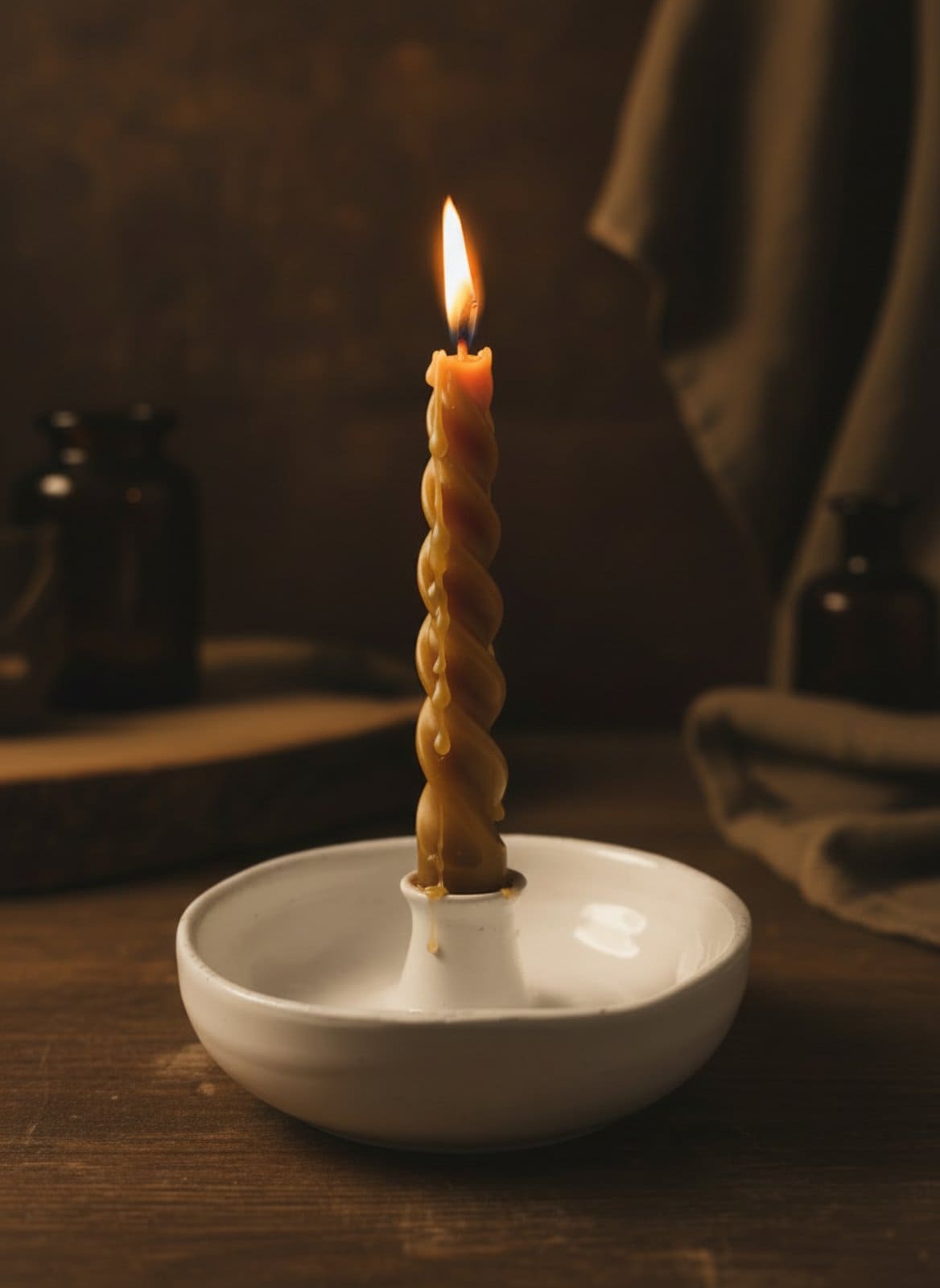
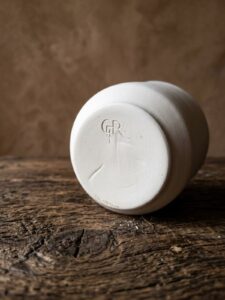
In The Ritual of Food, the jug “Roi” and the salad bowl “Gi”, in white and earthy brown, are shaped by hand. The egg cup “Avgi” shows that the same care fits even the smallest vessel of the morning. The candle holder “Phos”, in matte white, keeps the faint irregularities of the shaping.
Machine glass is invisible. Hand-blown glass has a body.
Every piece takes its shape from a breath, and no breath is the same as the one before. In the Water Chapter, Glass: The Breath of Water and the vases The Raindrop and The Sphere of Water hold small bubbles of air inside them. It is not a defect. It is the moment when the glass was still liquid.
For how this glass is born, read Water: Translating the Fluid into Matter.
Wood needs no artisan to be different every time. The tree has already seen to it.
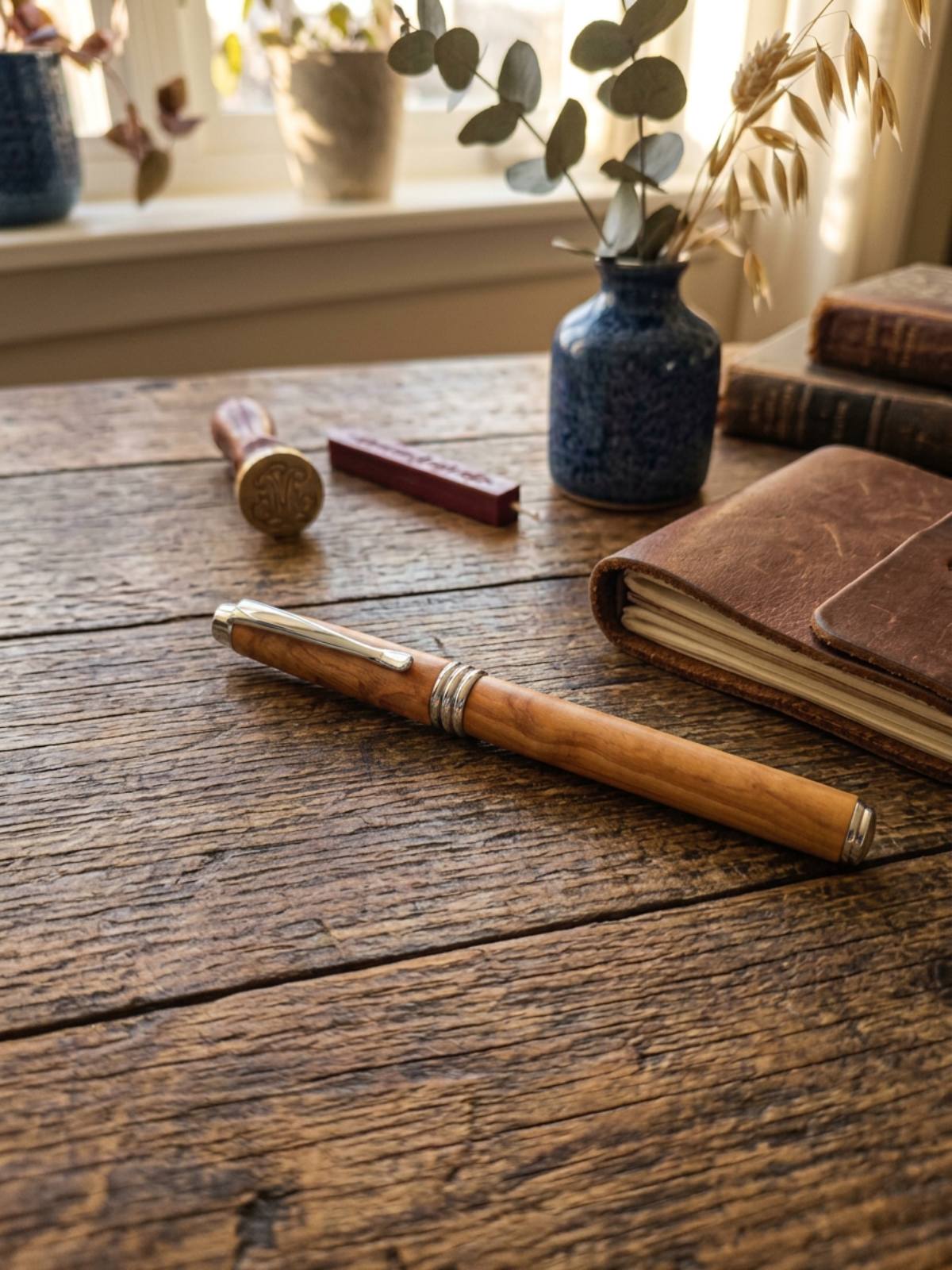
The grain of olive never repeats. In the Olive Fountain Pen and the Olive Wood Letter Opener, the wood comes from pruning, and every grip has a pattern of its own.
In Pagondas we did not have the word wabi sabi. We had the thing.
The whitewashed ledge that is never straight. The storage jar with its patch. The weaving where the weaver changed thread halfway, because the first one ran out.
At GRAMMA House we call it the Imprint. It is the small difference the hand of the artisan leaves on every piece: a bubble in the glass, a faint line in the ceramic, a seam that shows. We do not correct it. It is the signature of the person who made it.
Japan gave the idea a name and a philosophy. The Aegean lived it without naming it. For the ethos behind this work, read GRAMMA Craftsmanship: Returning to the Human Scale.
Not through renovation. Through subtraction and attention.
Empty first. Wabi sabi wants space around the object. A shelf with three things says more than a shelf with thirteen.
Keep what has a story. Your grandmother’s table, the cracked plate you love, the chair with the worn rush seat. They are not replaced. They are already what you are looking for.
Choose materials that age well. Wood, clay, linen, stone, glass. Avoid whatever looks good only while it is new.
Few colors, of the earth. White, beige, gray, brown. The eye rests, and the one object that stands apart is seen.
One thing made by hand in every room. A bowl in the kitchen, a vase in the living room, a mug on the desk. One is enough to change the tone of a space.
Something alive, and not flawless. An olive branch instead of a bouquet. It will dry, and it will be beautiful then too.
Use them. The most important of all. The good dinner service that comes out twice a year never acquires sabi. The everyday mug does.
What wabi sabi is not
The word became a fashion, and with fashion came misunderstandings.
It is not carelessness. The uneven bowl of an artisan has years of work behind it. The imperfection that moves us comes from the hand that knows, not from the hand that hurries.
It is not a style bought ready-made. A new piece of furniture made in a factory to look old is the opposite of wabi sabi. Patina cannot be printed.
It is not minimalism. Minimalism subtracts until what remains is clean and uniform. Wabi sabi subtracts too, but keeps the rough, the uneven, the warm.
It is not clutter. The wear of time is a different thing from neglect. A wabi sabi home is cared for. It simply does not hide its age.
With the hands
Wabi sabi is understood better with the fingers than with the eye.
Anyone who has sat once at the wheel knows how hard it is to make a bowl symmetrical, and how little that matters once they finally hold it in their hands. The first bowl always comes out crooked. And it is always the one that is never thrown away.
At the Workshop The Art of Earth & Wheel, at the atelier of the House in Pagondas, you work the clay with your own hands. You will find more about how it unfolds in The Art of Earth and Wheel: An Experiential Ceramics Workshop in Samos.
What does wabi sabi mean, in simple terms?
It is the Japanese idea that beauty lies in the imperfect, the impermanent, and the simple. An object is beautiful because it shows that a person made it and that time has touched it, not in spite of that.
How does wabi sabi differ from minimalism?
Both prefer the few. Minimalism loves the smooth, the straight, and the new. Wabi sabi loves the rough, the uneven, and the old. A minimalist room looks untouched. A wabi sabi room looks lived in.
Is wabi sabi the same as kintsugi?
No. Wabi sabi is a way of seeing beauty. Kintsugi is the technique of repairing broken ceramics with lacquer and gold. The second is one application of the first.
Which materials suit wabi sabi?
Those that are natural and age well: clay, wood, stone, linen, hand-blown glass, metal that takes on a patina. If a material looks worse with the years, it does not belong.
How do I begin, without changing the whole house?
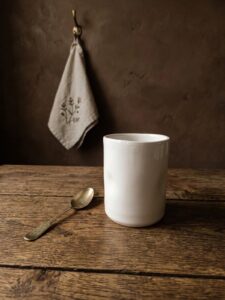
With one object you will use every day. A mug shaped by hand for the morning coffee is beginning enough. After that, remove rather than add.
Is a bubble in the glass or a line in the ceramic a defect?
In handmade pieces, no. It is the trace of the work. At the House we call it the Imprint, and it is the reason no two pieces are ever the same.
Nothing is perfect, and that is enough
Wabi sabi is not something one acquires. It is something one learns to see.
It begins with an object you hold a little longer than you need to. With a mark you decide not to erase. With a bowl that is not round, and that you prefer.
Discover the Chapters of the House, where every piece carries its Imprint.
This is GRAMMA.