
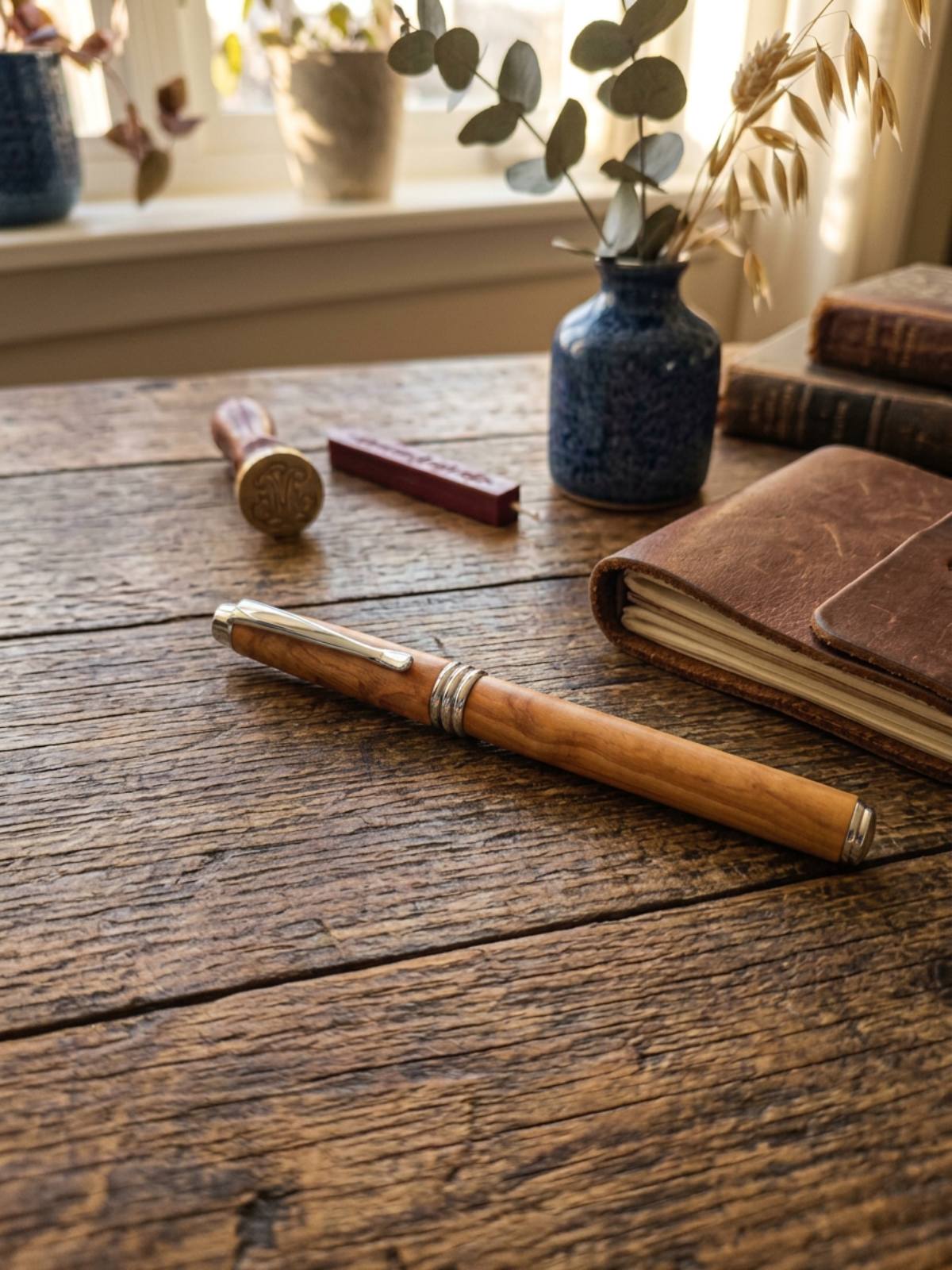
A wooden fountain pen does not write faster than a keyboard. It writes more slowly, and that is the reason to keep one.
The screen corrects, deletes, suggests. Paper keeps whatever you give it, in the order you thought it. Whoever writes by hand chooses the words before letting them go, because there is no undo key.
This guide is for anyone thinking of owning a first fountain pen, or of giving one. It explains what to look for, how a pen is filled, how it is cared for, and how to begin writing every day. The examples come from the olive wood pens of GRAMMA House.
A ballpoint has a tiny ball at its tip. To write, you have to press it into the paper.
A fountain pen has no ball. It has a metal nib with a fine slit down the middle. The ink travels down the slit on its own, the moment the nib touches the paper. No pressure is needed. The hand simply guides.
Every difference follows from this:
Most fountain pens are made of resin or metal. They are smooth, identical, cold at first touch.
Wood is warm from the first moment. Its grain never repeats, so no two pens are the same. And it does not slip in the fingers the way polished metal does.
Olive in particular is a dense, hard wood with strong dark grain. The wood in the pens of the House comes exclusively from pruning. No tree is cut down to make a pen. And each one bears the GR logo of the House.
Four things are worth looking at.
The nib. It is the heart of the pen. It decides whether the writing flows or catches. The nibs in the pens of the House are made in England.
The way it fills. Some pens take only ready-made cartridges. Others fill from a bottle, with a small mechanism called a converter. The bottle means freedom: any ink color you wish, and no plastic to throw away.
The cap. A screw cap closes tightly. The nib does not dry out, and the pen does not open inside a bag.
The finish. Here the eye chooses.
The olive wood pens of the House all fill from a bottle and come in three versions:
Ink is not included. You choose it yourself.
The first time it seems difficult. The second time it is already a habit.
Use only fountain pen ink. Drawing and calligraphy inks are thicker and clog the nib.
The grip. Loose, with the slit of the nib facing up, at an angle of about forty-five degrees. If the pen scratches, the pen is not at fault. You have turned it.
The pressure. None. Let the weight of the pen do the work.
The paper. Smooth, slightly heavier paper keeps the ink on the surface. On thin copy paper the ink spreads and shows through to the other side.
The ink. Begin with black or blue-black. They dry quickly and read well everywhere. Colors come later.
A pen that writes every day needs almost nothing. Use keeps it alive.
The nib. Every few weeks, or when you change color, rinse the nib and the mechanism with cool water until it runs clear. No hot water, no alcohol. Let them dry on a cloth.
The wood. The pens of the House have a varnish that protects the olive wood. A dry, soft cloth is enough. The wooden part never goes under the tap, and is never left in the sun or on a radiator.
Storage. Always with the cap on. If you will not write for a long time, empty the ink and rinse the nib before putting the pen away.
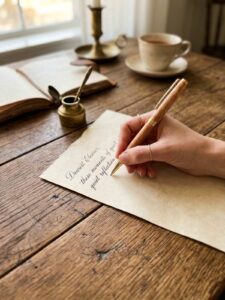
A fountain pen does not ask for long texts. It asks for frequent ones.
The mistake most people make is to begin with an empty notebook and the demand to fill a page. By the second week the notebook stays in the drawer. Begin with less.
For what the letter means to the House, read Letters: Opening the Envelope.
If you do not know what to write, the book The Maze: A Manual of Introspection has questions ready. You choose one and answer it on paper.
Of the four practices, keep only one. Write every day at the same hour, at the same table. This is how it becomes a habit, without effort.
The fountain pen is for the hours you sit. For the note taken standing, there is the Olive Pen, with the same olive wood grip, in Gold & Olive and in Silver & Olive.
The Olive Wood Letter Opener opens the envelope without tearing it. A wooden handle, a metal blade, six inches long.
The Olive Wood Maze sits beside the paper. You guide the small sphere to the center before you pick up the pen. It is a way for the hand to arrive at the desk first, and the mind after.
A fountain pen is among the few gifts that are used for years. It suits a graduation, a new job, someone who writes, and someone who would like to begin.
Two things to remember when you give one. Ink is not included, so a bottle of black fountain pen ink makes it ready from the first day. And together with the Letter Opener, it becomes a gift for the whole desk.
You will find more suggestions in our article Handmade Christmas Gifts.
Is it hard to write with a fountain pen?
No. It takes ten minutes for the hand to find the angle, and to unlearn the pressure of a ballpoint. After that a fountain pen writes more easily than anything else, because it asks for no force.
What ink does a wooden fountain pen need?
The same as any fountain pen: fountain pen ink, in a bottle. The material of the grip changes nothing. The olive wood pens of the House fill from a bottle, which is not included. Avoid drawing and calligraphy inks.
Can left-handed people write with a fountain pen?
Yes. The only issue is that the hand passes over fresh ink. A quick-drying ink helps, as does paper that absorbs it, and keeping the hand a little below the line.
How often should a fountain pen be cleaned?
Every four to six weeks if you write regularly, and always when you change ink color. Cool water, until it runs clear.
What do I do if the pen will not write?
Usually ink has dried in the nib. Rest the nib for a few seconds on a damp tissue, or rinse it with cool water and fill again. If you write even one line a day, it will not happen.
Does olive wood need special care?
Very little. The varnish protects it. Keep it away from water, sun, and heat, and wipe it with a dry cloth.
Is a fountain pen a good gift for someone who has never used one?
Yes, as long as it comes with a bottle of ink. The Silver & Olive Fountain Pen with its screw cap is a safe beginning.
What is written by hand stays differently. On the paper, and in the one who wrote it.
A wooden fountain pen is not a tool of speed. It is a reason to sit down, unscrew a cap, and let a thought reach the end of the line.
Make yours the pen that will write your own letters.
This is GRAMMA.