
At the core of every great creation, whether it is a monumental temple or a flawlessly tailored garment, lies a fundamental need: the human desire to find balance within chaos. The Origin of Arpedoni is not just a technical piece of the history of mathematics. It is a narrative about how one of the humblest materials—a simple, rough rope—managed to unlock the secrets of space and lay the foundations for what we now call sacred geometry.
To truly understand The Origin of Arpedoni, we must travel millennia back in time, to where the sand meets the water, on the fertile banks of the Nile River.
In Ancient Egypt, life and death, prosperity and destruction, were determined by a single factor: the annual flooding of the Nile. Every summer, the river’s waters swelled and covered the valley, depositing the precious, black silt (mud) that made the land fertile. This life-giving process, however, came at a price. As the waters receded, they erased every natural or artificial boundary. The farmers’ fields became a single, indistinguishable canvas of mud. The landscape lost its memory.
It was exactly this moment of absolute chaos that gave birth to the need for redefinition. The state had to redraw the boundaries, measure the land to serve justice, and calculate taxes. The word geometry (geo-metria, the measuring of the earth) was not an abstract concept, but a highly practical, vital process of survival. It is within this critical condition that the historical Origin of Arpedoni is found.

To restore order to the muddy landscape, the Pharaohs employed a special caste of people, the artisan-priests who went down in history under the Greek name “Arpedonaptes” (rope-stretchers). The word derives from arpedoni (a thick rope or thread) and the verb apto (to tie, fasten, stretch).
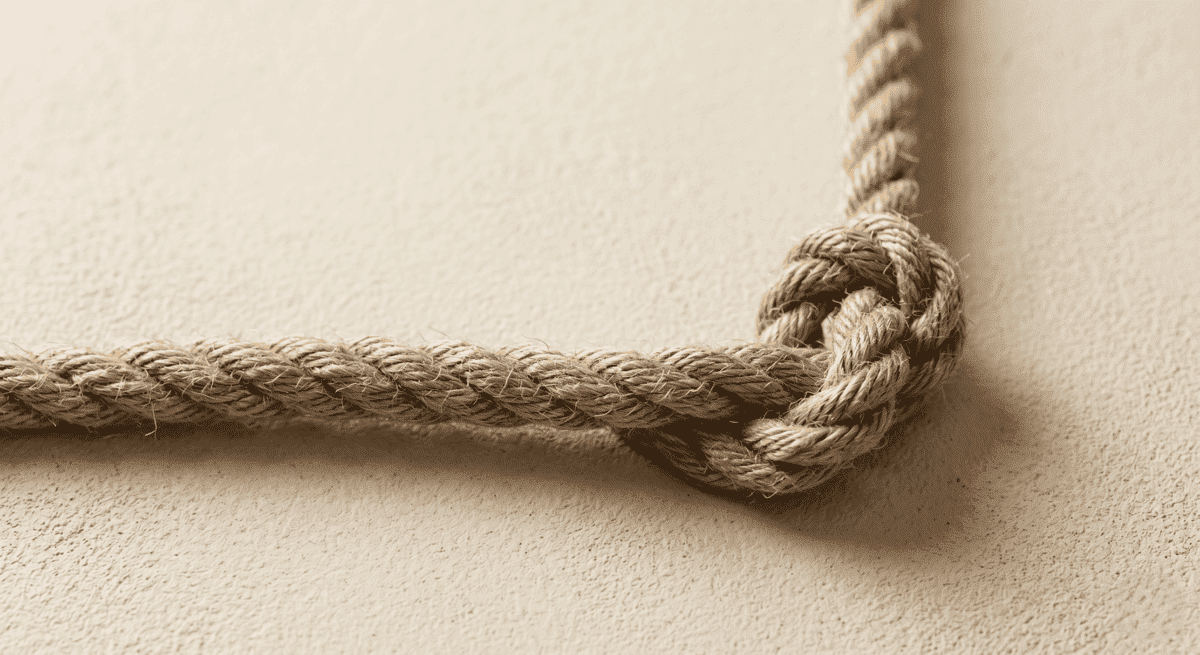
These men did not hold complex instruments, but only a durable rope made of braided plant fibers. Yet, this rope possessed a specific feature that resembled a secret code, like a multi-layered mystery unfolding before the eyes of the uninitiated. It was divided into equal intervals using carefully tied knots. Each knot represented a chapter of deeper knowledge, a reference point upon which the entire structure of their world would rest.
The Origin of Arpedoni as a scientific tool lies precisely in this arrangement of knots. The Arpedonaptes knew that if they took a rope divided into 12 equal segments (thus having 13 nodal points if we join the ends) and stretched it on the ground using pegs, they could form a triangle.
If the sides of this triangle had lengths of 3, 4, and 5 segments respectively, something magical happened: the angle formed between the sides of length 3 and 4 was always, inescapably and absolutely, a perfect right angle (90 degrees). The malleable, airy material of a rope was instantly transformed into a rigid rule, a tool of absolute precision.
This discovery went far beyond agricultural needs. The Origin of Arpedoni was very quickly linked to religion itself and the art of building. The right angle meant stability. It meant that the walls of a building would not collapse, that the columns would stand proud and parallel, conceptually uniting the earth with the sky.
When we stand in awe before the imposing structure of the Pyramids of Giza or wander through the shaded corridors of the temples of Karnak and Luxor, what we are witnessing is the materialized Origin of Arpedoni. The Ancient Egyptians could never have aligned these monuments with such astounding astronomical and geographical precision without the “rope-stretchers.”
This tool became the symbol of a vision taking flesh and bone. It showed humanity that harmony is not something that merely happens in nature, but something that can be constructed, as long as you respect proportions, distances, and your material.
It is awe-inspiring to think how a piece of braided plant could define space. The tension that developed when the artisans pulled the arpedoni reflected the continuous balance between strength and fragility, between the rigid and the fluid. The thread dictated the form, and the form embraced the space.

The knowledge of this thread was too profound to remain confined within the borders of Egypt. The Origin of Arpedoni was only the first act of a story that would forever change human thought. That ancient string with its carefully measured knots waited patiently for the man who would discern, behind its practical use, the very rhythm of the universe.
This thread was destined to cross the Mediterranean Sea, reach an island in the Eastern Aegean, Samos, and meet the most brilliant mind of antiquity, giving birth to the theorem that would be named “Pythagorean.” But that is a story for the next article of our journey.
What is arpedoni? It is a rope knotted at equal intervals, used in Ancient Egypt by the “harpedonaptai” to measure land. The word comes from “arpedoni” (a thick rope) and the verb “apto” (to tie, to stretch).
Why did the land need to be measured again? The yearly flood of the Nile erased the boundaries of the fields. The state had to mark them again, and so geometry (“the measuring of land”) became a practical need.
How did a rope make a right angle? The rope was divided into 12 equal parts and stretched into a triangle with sides of 3, 4 and 5. The angle between the sides of 3 and 4 was always a right angle.
See also: Pythagoras and Arpedoni · Chapter Arpedoni